Systems reasoning / Engineering portfolio

Not screens.
Decisions.

Twelve cases showing what was hard, what I changed and why the decision matters. Expand a case to inspect the reasoning, code and working model.

Explore business rules, integration, data engineering and platform architecture through working examples and technical decisions.

Reading depth: case headlines remain visible; expand technical reasoning and evidence when wanted.
Portfolio method

The decisions that make systems work.

Every case starts with an operational problem and follows it through the design decisions that made it solvable. Explore the business rules, architecture, failure handling and implementation choices behind systems people use.

The examples span production foundations, operational scripts, prototypes and implementation handoffs. Each includes the context needed to understand its purpose, design and tradeoffs.

The complexity is rarely one line. The important work is choosing the right state, preserving the invariants across time and systems, anticipating contradictory records, and making the result recoverable and explainable. These cases connect the implementation to its counterexamples and interacting rules.
Direct excerptLightly shortened source code.
SimplifiedImplementation reduced to its essential idea.
ConceptualFaithful reconstruction of a designed rule.
Decision artifactArchitecture or commercial reasoning.
01 · Booking intelligenceDomain-model authorship: reconstructing fair history from mutable records. 02 · Defensive matchingConfidence, ambiguity and imperfect operational data. 03 · Time qualificationDirect C# implementation of a difficult temporal policy engine. 04 · Recruitment integrationProtocol reconstruction and durable multi-system operation. 05 · population-data pipelineCompletion-driven PowerShell concurrency at verified scale. 06 · Responsible reuseUnderstanding and owning an adapted dependency. 07 · Scheduling intelligenceOperational capacity between geographic and temporal constraints. 08 · Governed Apps ScriptAccess, concurrency and state in a business workflow. 09 · Offline foundationService-worker behavior as explicit routing policy. 10 · Insight lineageChanging the abstraction when the business invariant changed. 11 · Platform ownershipSmall-platform security, recovery and proportional capacity. 12 · Commercial systemsTurning technical work into a governable engagement.
Part I · Domain intelligence

Turning messy reality into rules

The strongest algorithms here begin with understanding what operational data actually means—not what its column names imply.

Case 01Temporal domain modeling
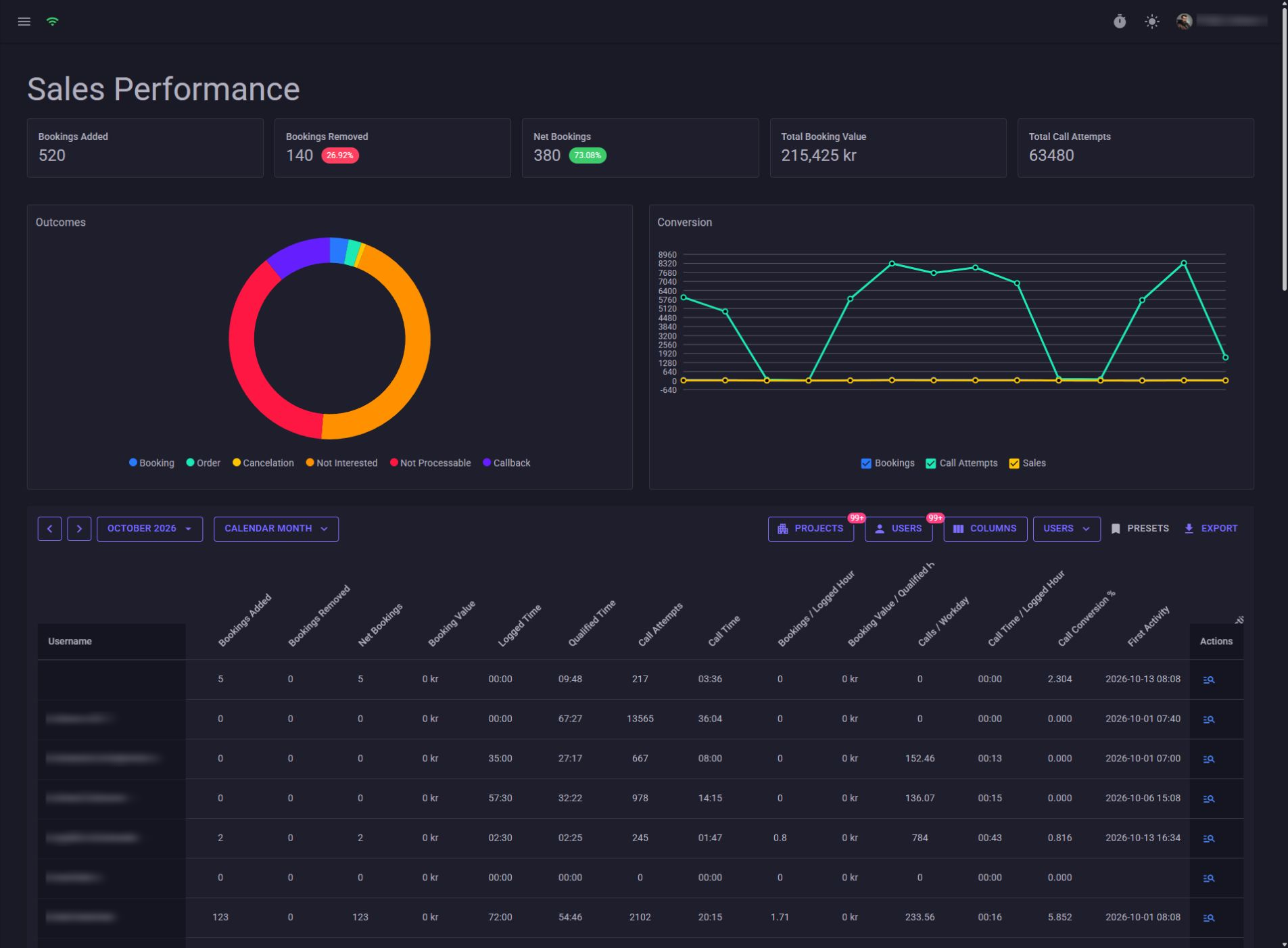
Fortis Insight · Sales Performance

A booking is not a row. It is a history.

Reconstructing fair performance from bookings, cancellations, deletions, rebookings and orders.

Explore the approach, code and outcome

The hidden problem

Counting records would reward duplicates, erase deleted production, place cancellations on the wrong date and sometimes credit the wrong agent. The data model stores mutable events; management needs a stable commercial history.

The decision

Group chronologically by customer, split sufficiently separated activity into project-configurable commercial cycles, then emit normalized credit and debit events. The original booking retains its owner and date; later fallout receives its own date.

What had to be understood

  • Customer identity across multiple process records
  • Difference between deletion and historical non-existence
  • Ownership through booking-to-order conversion
  • Reporting-window boundaries and downstream aggregation
Direct excerpt · layer 1 of 3Cycle boundary detection
foreach (var customer in bookings.GroupBy(x => x.CustomerId)) {
  var history = customer.OrderBy(x => x.CreationTime).ToList();
  var cycle = new List<SalesProcessShortDto>();

  for (int i = 0; i < history.Count; i++) {
    var current = history[i];
    var next = i + 1 < history.Count ? history[i + 1] : null;
    cycle.Add(current);

    if (next != null &&
        next.CreationTime.Subtract(current.CreationTime).Days
          >= current.ClusteringDays) {
      clusters.Add(cycle);
      cycle = [];
    }
  }
  clusters.Add(cycle);
}
The rules that make the loop meaningful
Historical conservationA deleted booking must still contribute +1 on creation and −1 on removal; otherwise past performance silently changes.
Temporal truthCredit belongs to the creation date. Fallout belongs to the later cancellation or modification date.
Identity continuityAn order created by a later system event remains attributable to the person who originated the booking.
Cycle separationThe same customer may represent a new opportunity after a project-specific inactivity window.
Direct excerpt · layer 2 of 3State-to-metric emission
// Preserve an active booking credit.
if (bookingCycle.Exists(x => !x.IsDeleted.GetValueOrDefault()))
  result.Add(addedBooking);

// A fully deleted history did exist: emit both sides of history.
if (bookingCycle.TrueForAll(x => x.IsDeleted == true))
  result.AddRange([addedBooking, removedBooking]);
else if (bookingCycle.Exists(x => x.OutcomeType == Cancelation))
  result.Add(removedBooking);

// Preserve originating ownership through conversion.
order.UserId = bookingCycle.Count != 0
  ? bookingCycle[0].UserId
  : orderCycle[0].UserId;

// Order deletion/cancellation follows the same historical rule.
if (orderCycle.TrueForAll(x => x.IsDeleted == true))
  result.AddRange([order, orderCancelled]);
Why a row count fails: Booking on 3 March, cancellation on 12 March, rebooking after the project window, then an order created by an integration user. A naive query can report two bookings in March, erase the first after deletion, charge the cancellation to 3 March, or credit the system user. The algorithm must avoid all four errors simultaneously.
Booking
credit at creation
→
Cancellation / deletion
debit at modification
→
Order
credited to booking owner
October 2026 · Testing the model against connected history

I clarified why the activity-gap rule exists: repeated cancellations, postponements and rebookings should stay in one commercial cycle, while a later independent sale should count again. A chain can extend beyond the gap threshold overall. Changing the report window must not change its original booking date or owner.

History before filteringRecover the connected cycle before applying report dates and user filters.
One addition per cycleCancellation must not become a second addition or replace the original credit.

I extended this reasoning to order identity, ownership, value and cancellation dates, using concrete records and counterexamples to challenge the behaviour.

Basis: service implementations, developer handoff examples and release history through 14 October 2026. Earlier implementation was delivered by a developer under my direction. The excerpts illustrate the historical model.

Engineering value

I designed and verified a model that coordinates temporal semantics, identity, attribution fairness, mutable records and reporting behaviour, then carried it through implementation, refinement and acceptance.

Case 02Defensive data enrichment
Hanna invoice workflow

Confidence is better than a false certainty.

Enriching invoices when names, addresses, people and map boundaries do not share one reliable key.

Explore the approach, code and outcome

The operational constraint

Property identifiers and personal identity numbers were required for daily invoice handling. Manual row-by-row lookup was so inefficient that users preferred waiting for the application when it was unavailable.

The reasoning pattern

Search from strongest evidence to weaker evidence, accept a match only when it is unique, record how the result was found, and use geographic fallbacks carefully rather than silently taking the first candidate.

Why it matters

The clever part is not scraping a page. It is refusing to convert uncertainty into incorrect invoice data while still recovering enough imperfect rows to make automation worthwhile.

Simplified from implementationPowerShell decision sequence
# Strongest evidence first; broaden only when necessary.
$strategies = @(
  @{ Query = "$name $street $city"; Confidence = 'exact' },
  @{ Query = "$name $city";         Confidence = 'reduced' },
  @{ Query = "$street $city";       Confidence = 'address' }
)

foreach ($strategy in $strategies) {
  $matches = Search-Person $strategy.Query
  if ($matches.Count -eq 1) {
    return @{ Person = $matches[0];
              Confidence = $strategy.Confidence }
  }
}

# Boundary ambiguity: test small coordinate offsets and label it.
return Find-UniqueProperty -Coordinates $offsetPoints
Evidence is degraded deliberately, never accidentally
StrategyAccept whenWhy it can failRecorded quality
Name + exact address + cityOne consistent personFormatting, c/o, spellingHigh confidence
Name + cityStill uniqueCommon namesReduced confidence
Address-centered searchUnique resident/ownerHouseholds and movesAddress-derived
Map coordinateOne parcel returnedPoint near parcel boundaryGeographic
Offset coordinate probesResults convergeNeighboring parcels disagreeFallback + review signal
Why first-result automation is dangerous: a plausible person and a plausible property can both be wrong while looking syntactically valid. The workflow's value is that ambiguity remains visible instead of being laundered into authoritative invoice data.

Basis: retained PowerShell enrichment workflow. This snippet is simplified, not a verbatim function. Strategy ordering and ambiguity protection are the relevant decisions.

Engineering value

Staged matching, ambiguity protection and geographic fallbacks turn unreliable source data into usable invoice enrichment. The evolved PowerShell implementation prioritises traceable decisions and safe handling of uncertain matches.

Case 03Policy as a temporal engine
Direct C#/.NET implementation · 2026

Fairness cannot be expressed as one threshold.

Replacing rigid clock hours with explainable qualification across activity spans, gaps, lunch, timezones and mixed project rules.

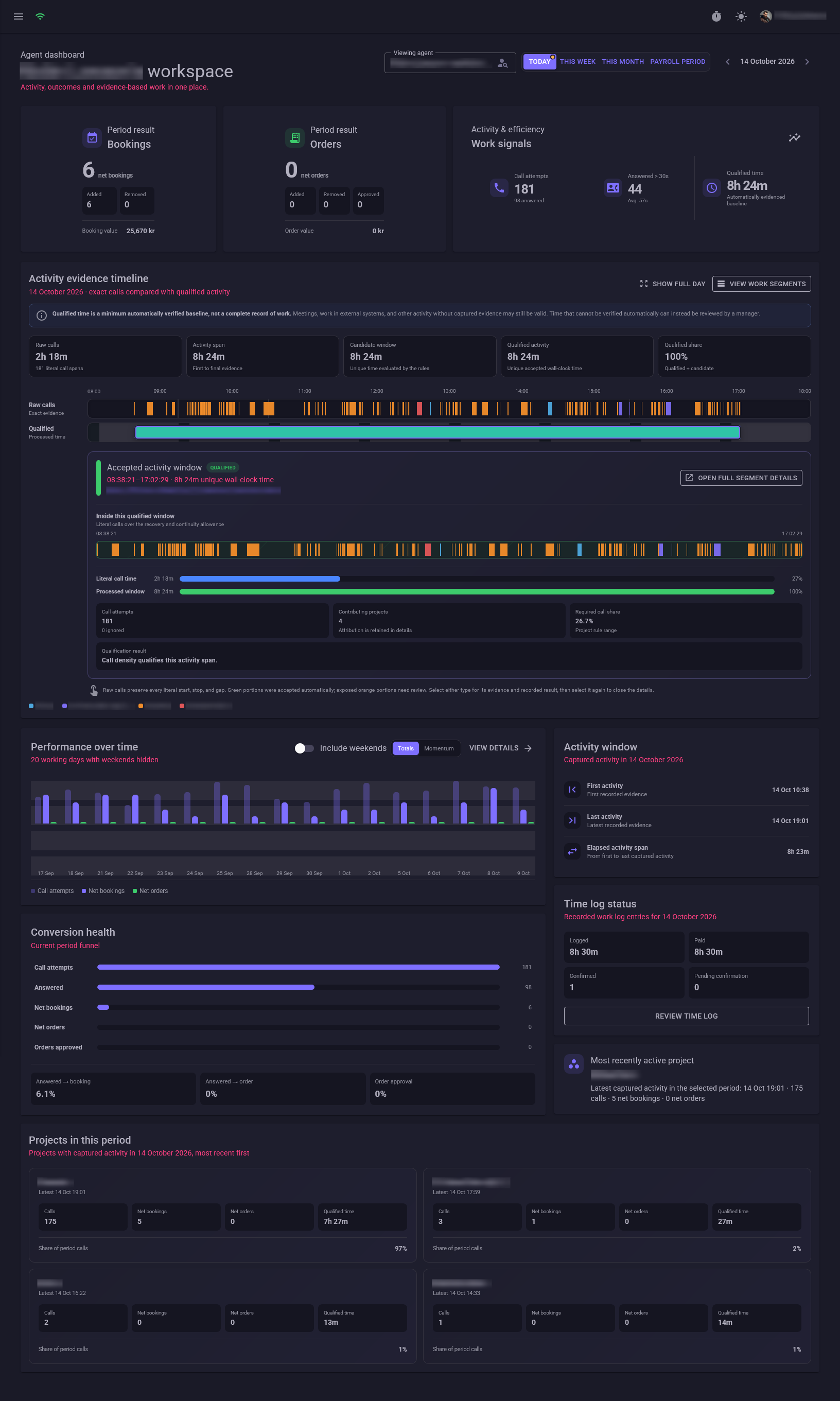
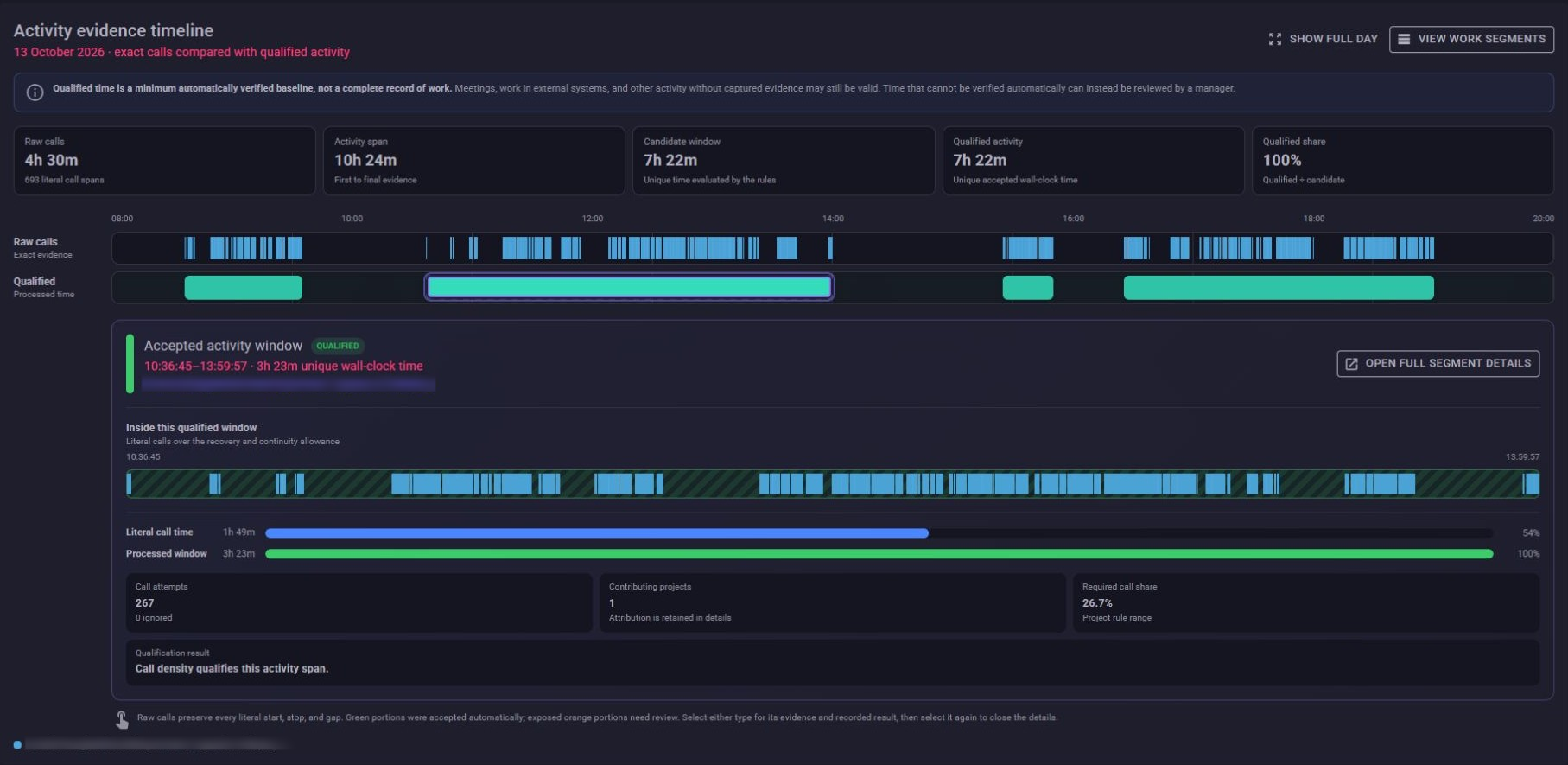
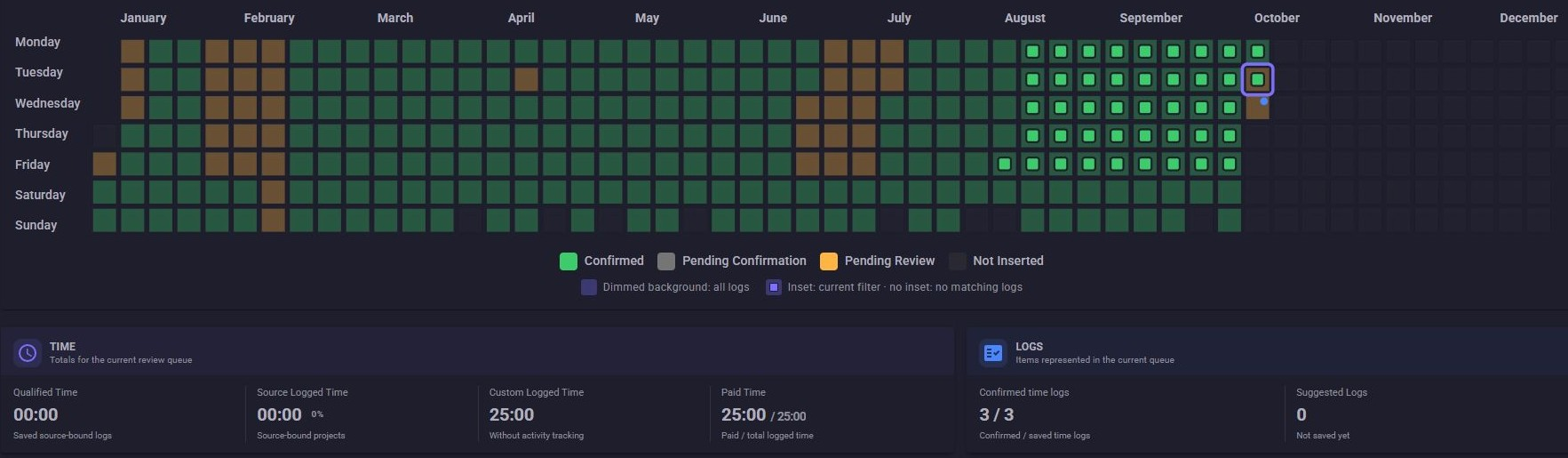
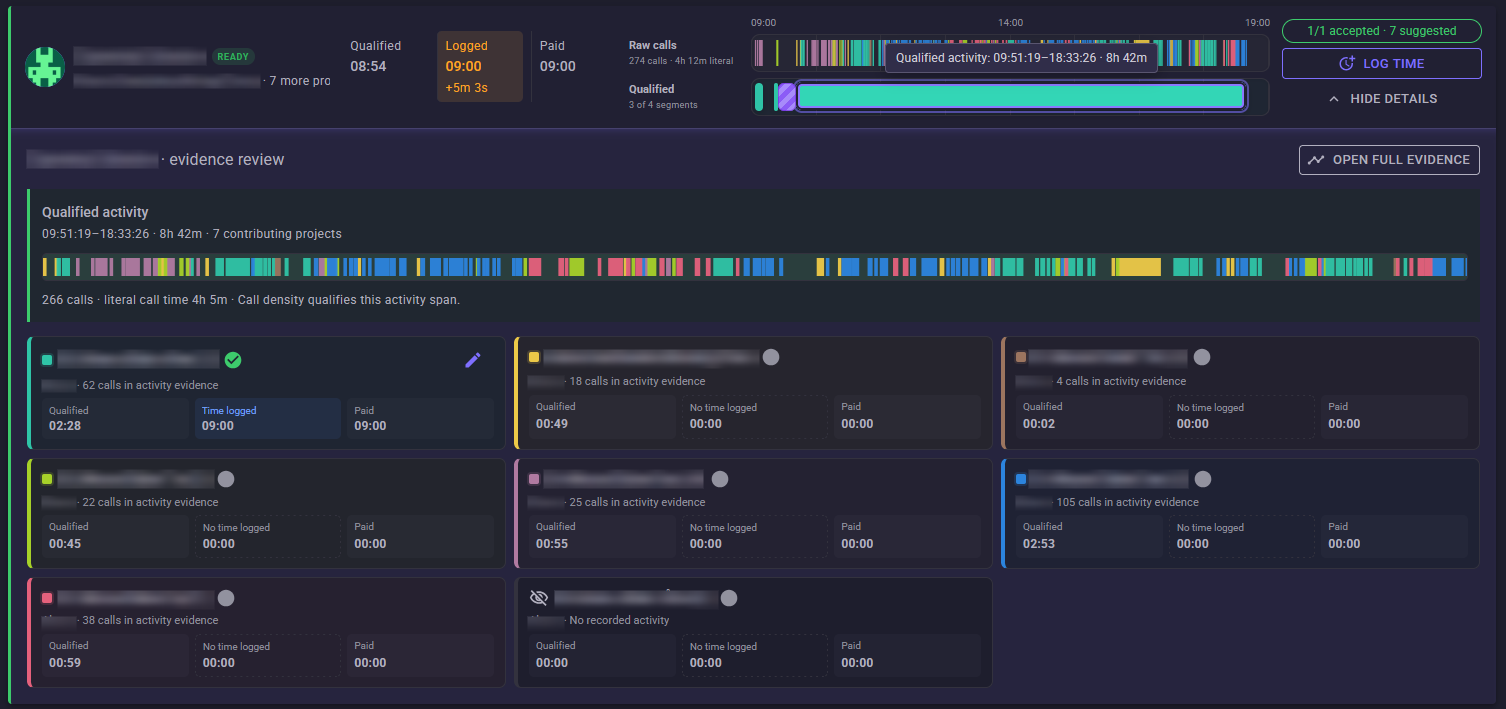
Observed activity and an interpreted qualified span remain separate. Selecting the span reveals supporting evidence and its rule.
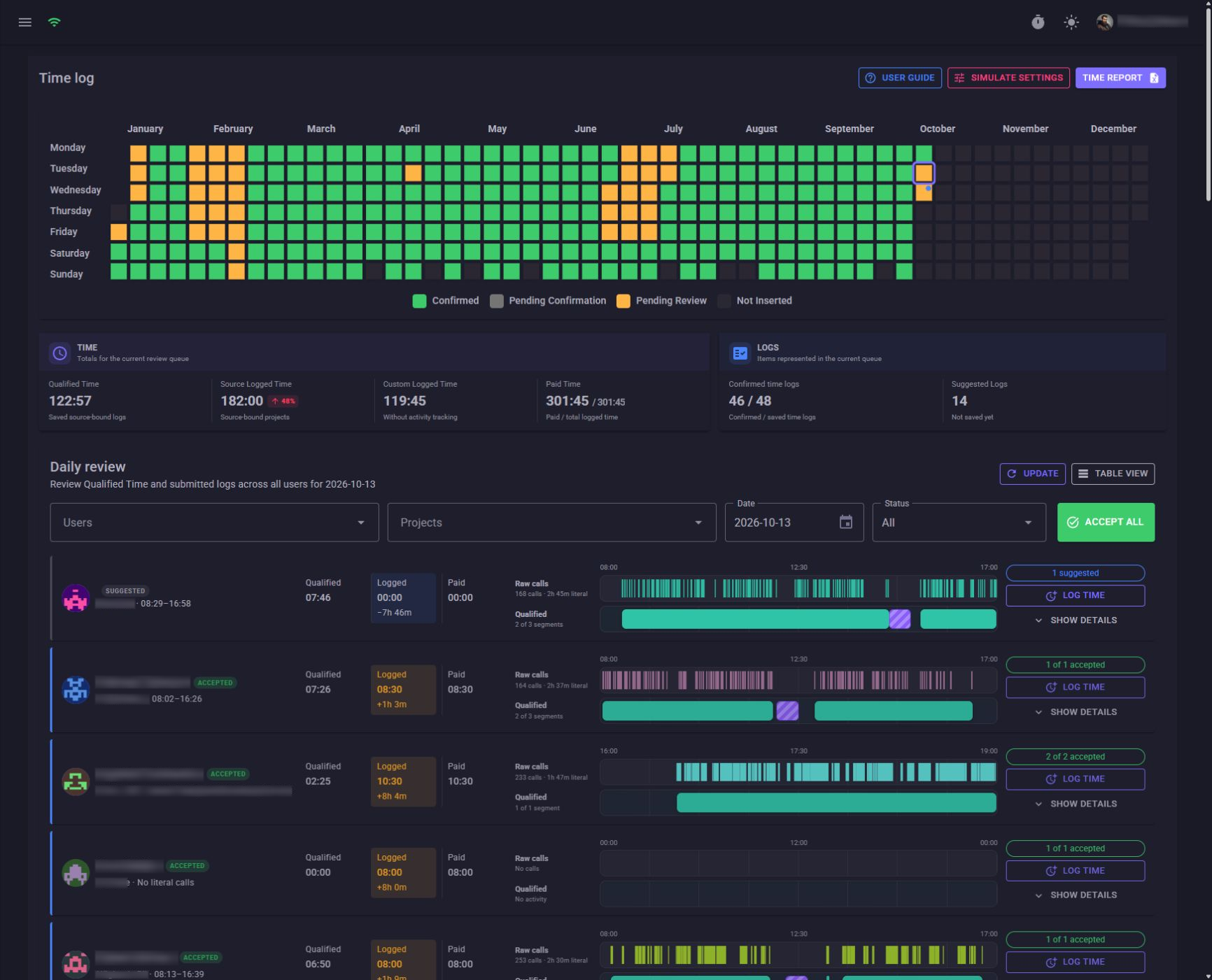
Make the result inspectable. This is an illustrative model, not real work data or an application capture. Qualified Time is a minimum automatically verified baseline, not a complete record of work. Inspect the protected Insight screenshots →
Explore the approach, code and outcome

The failed simple rule

Accepting isolated clock hours by a fixed call-minute threshold misreads real work: calls cross hour and midnight boundaries, projects require different densities, legitimate gaps occur inside productive spans, lunch divides the day, and partial final periods still represent work.

The implemented model

I personally rebuilt the feature as a day-level temporal qualification engine. Calls become clipped local-day intervals; project thresholds become support ratios; qualifying spans are found across interaction boundaries; continuity, lunch and missing time remain explicit rather than disappearing into a flat total.

Why direct implementation matters

I normally communicate difficult logic for developer implementation. Here the interacting rules lost too much fidelity through words, diagrams and interpretation, so I crossed the delegation boundary and completed the complex core myself. The resulting commit coordinates domain policy, algorithms, service logic, DTOs, aggregation and diagnostic UI. Its history is equally telling: first a complete interval model, then focused corrections around culture, lunch semantics, status recalculation, future-date safety, zero-duration calls, input consistency and operational review. The development followed an outcome-led loop: model the real business, inspect the consequence, tighten the boundary, and keep any remaining human judgement visible rather than pretending every decision can safely be automated.

Simplified from direct implementationTemporal qualification pipeline
localWindow = convertDayToUtcQueryWindow(date, timezone)
calls = queryOverlapping(localWindow)
        .convertToLocalTime()
        .clipToDay()

gaps = deriveTimelineGaps(calls)
lunch = selectEligibleLargestGap(gaps, workSpan, settings)
clusters = splitOnLunchOrUnrecoverableGap(calls, gaps)

for each cluster:
    boundaries = distinct(call.starts + call.ends)
    supportPrefix = accumulate(
        intervalSeconds / project.requiredCallRatio)
    qualified = recursivelyFindLongestSupportedSpans(
        boundaries, supportPrefix)
    emitQualifiedAndMissingSegments(qualified)

emitLunchAndGapExplanations()
allocateResultsAcrossProjects()
Interacting constraints handled together
Observed dayNaive hourly resultDay-level interpretation
Calls cross midnight or daylight boundariesWrong day or missing interactionLocal-day window converted to UTC, then clipped after conversion
Two projects require different call densityOne threshold miscredits timeProject ratios contribute weighted support and effective settings
Productive work contains short gapsFragmented or over-credited dayBase allowance plus capped recovery grows from supported activity
Lunch divides an otherwise valid dayAdjacent activity rejectedLargest eligible gap is classified, limited and explained separately
The non-obvious constraint: call seconds are not payable seconds. They are evidence that can support a larger candidate span according to each project's required density. That support must be partitioned across time and projects without allowing unlimited gaps or erasing legitimate lunch.

Basis: my FI-2663 work from 17–29 July 2026. Direct policy, service, UI, validation and behaviour-refinement work, not sole authorship of later team extraction. A clean build applies to an earlier feature head, not an independently rebuilt current branch. Fairness-policy validation is scenario-driven manual review.

Engineering value

This work brings temporal domain modelling, interval algorithms, multi-policy attribution, timezone correctness and explainability together in an end-to-end .NET/Blazor feature. Validation combined an integration build with repeated manual review of whole-day outcomes. That review tested the fairness policy against operational reality; automated regression coverage for the chosen scenarios and mechanical invariants remains a next step.

Part II · Engineering under constraints

When the obvious route does not exist

These cases show protocol discovery, concurrency control, recovery and careful use of limited execution environments.

Case 04Protocol reconstruction
job board → applicant tracker → telephony platform

Rebuilding a browser-only authentication journey.

Email OTP, authenticator MFA, cookies, browser fingerprints and undocumented GraphQL—without a supported basic-auth integration.

Explore the approach, code and outcome

The real task

job board did not expose a convenient authentication flow for this integration. The solution had to reproduce the behavior of a browser session, trigger an email code, retrieve it through a controlled endpoint, generate TOTP locally, retain evolving cookies and then call undocumented operations.

Not one workaround

The solution spans transport fingerprinting, form semantics, cookie lifecycle, MFA cryptography, error diagnostics, pagination, durable state and cross-system reconciliation.

Operational outcome

About 60 daily applications could enter a governed pipeline instead of growing an unmanageable manual backlog. Estimated lost or delayed candidates fell by 60–75%.

Direct excerpt · one subsystemPowerShell TOTP implementation
$key = Convert-Base32ToBytes -Base32 $Secret
$unix = [DateTimeOffset]::UtcNow.ToUnixTimeSeconds()
$counter = [Math]::Floor($unix / $Period)

$counterBytes = [BitConverter]::GetBytes([Int64]$counter)
if ([BitConverter]::IsLittleEndian) {
  [Array]::Reverse($counterBytes)
}

$hmac = [Security.Cryptography.HMACSHA1]::new($key)
$hash = $hmac.ComputeHash($counterBytes)
$offset = $hash[-1] -band 0x0F
$binary = # RFC dynamic truncation
$otp = $binary % [Math]::Pow(10, $Digits)
The actual authentication state machine
01 · Shape transportTLS ciphers, HTTP/2 settings, browser headers and cookie behavior
02 · Email identitySubmit account identifier and preserve hidden form state
03 · OTP challengeTrigger email OTP, poll controlled endpoint and validate code
04 · OTP verifyPost correct form semantics and update cookies from every response
05 · MFA discoverParse changing form action, hidden fields and authenticator field name
06 · TOTP submitGenerate time-based code, submit relative/absolute action and capture PPID
07 · GraphQL useReplay session headers, paginate undocumented operations and inspect token state
08 · RecoverDistinguish auth failure, challenge, renewal candidate, rate limit and terminal error
Direct excerpt · recovery policyRetry only when session evidence changed
$diagnostics = Get-job boardGraphQLErrorDiagnostics $json.errors

$retryAfterRefresh = (
  $attempt -eq 1 -and
  $diagnostics.IsAuthFailure -and
  $result.AuthContext -and (
    $result.SetCookieCount -gt 0 -or
    $result.AuthContext.UpdatedPPID -or
    $result.AuthContext.Reason -match
      'GraphQlRenewalCandidate|PageChallenge|CachedApiHeaders'
  )
)

if (-not $retryAfterRefresh) {
  throw (New-job boardGraphQLErrorMessage
    -Diagnostics $diagnostics
    -AuthContext $result.AuthContext)
}
Why “just use curl” fails: a request can return HTTP success while GraphQL reports an auth error; a response may rotate cookies without returning the final token; the MFA form action and hidden fields can change; retrying every failure can duplicate requests or trigger rate limits. Recovery must depend on observed session transitions.
Browser-shaped
TLS + headers
→
Email OTP
retrieval
→
TOTP
generation
→
Cookie + GraphQL
session
Authentication unlocks a second distributed workflow
job board + Facebook + Instagram + other sources
→
applicant tracker authoritative candidate identity
→
telephony platform/Provider A calling intake
→
Call outcome reconciliation
→
applicant tracker stage move or rejection
IdempotenceRe-running ingestion must update known candidates rather than duplicate them.
Authorityapplicant tracker becomes the recruitment state of record even when intake begins elsewhere.
Resume safetyPagination and persistent SQLite state allow interruption without restarting blindly.
Policy isolationDry runs and action policies separate observation from external mutations.

Basis: retained authentication and synchronization implementation. Provider names and private endpoints are omitted. Illustrations describe the mechanism, not a reusable credential or authentication bypass.

Engineering value

Protocol-level reasoning, cryptographic implementation and stateful HTTP engineering made an authorised company integration dependable in production. Session recovery and request validation are part of the design, not afterthoughts.

Case 05Staged concurrency
National-scale data pipeline

Concurrency shaped around the work—not added afterward.

A multi-stage PowerShell workflow for national-scale acquisition and enrichment.

Explore the approach, code and outcome

The verified scale

The live MSSQL table contains 7,947,815 person records. On 23 June 2024 it records 502,253 distinct population-data IDs completed that day, with zero duplicate IDs and a unique index on Rid. Even spread across all 24 hours, that establishes a conservative floor of 20,927 completed individuals per hour.

The architecture

Six stages have different workloads and dependencies. Completed work feeds the next stage without waiting for a national batch, while stage-specific capacity prevents fast discovery work from flooding expensive person processing. Recent runtime measurements also regulate the pool's maximum concurrency.

The development evidence

Local History records the evolution from parallel pipelines and job mechanisms through direct asynchronous runspaces, tagged work, completion handling, injected worker state and explicit lifetime management. A separate reduced Slow Debug project compares transports, parsers, apartment models, thread reuse, batching, process isolation and cleanup rather than guessing at the bottleneck.

Operational controls

  • Reusable MTA runspace pool with thread reuse and injected session state
  • Completion-driven result collection and bounded downstream pressure
  • Adaptive maximum runspaces calculated from recent completion time
  • Retryable incremental persistence, cache decisions and repair paths
  • Live stage occupancy, throughput, latency, memory, bytes and proxy-cost monitoring
  • Persisted launcher state for selection and runtime configuration
Direct excerptPowerShell runspace engine
$pool = [RunspaceFactory]::CreateRunspacePool($iss)
[void]$pool.SetMinRunspaces($minRunspaces)
[void]$pool.SetMaxRunspaces($maxRunspaces)
$pool.ApartmentState = 'MTA'
$pool.ThreadOptions = 'ReuseThread'
$pool.Open()

$runspace = [PowerShell]::Create()
$runspace.RunspacePool = $pool
[void]$runspace.AddScript($scriptblocks.$params.block)
[void]$runspace.AddArgument($params)

$jobs.Add([pscustomobject]@{
  Status  = $runspace.BeginInvoke()
  Pipe    = $runspace
  Stage   = $params.block
  Created = Get-Date
})
The runspace is only the execution primitive
A · MunicipalityExpand selected municipalities into postcode partitions
B · PostcodeDiscover streets within each postcode partition
C · StreetExpand streets into numbered address partitions
D · Street numberDiscover registered-resident listing pages
E · ResidentsEnumerate individual person URLs from completed listings
F · PersonRetrieve, enrich, normalize and persist complete person records
MonitorMeasure queues, throughput, bytes, runtimes and completion
BackpressureApply different concurrency limits to network and database pressure
No national barrierA completed upstream partition can feed its next stage without waiting for every municipality.
Bounded pressureConcurrency is a control variable per workload, not “as many threads as possible.”
Disposable workersEvery completed or failed pipeline is drained, cleared, disposed and removed.
Restartable progressPersisted work and retry behavior prevent one failure from invalidating a long acquisition run.
Why parallel foreach is insufficient: six stages have unequal latency, memory use and database pressure. A single global concurrency number either starves cheap stages or overwhelms expensive ones; a batch barrier leaves downstream capacity idle; failure without durable progress wastes hours of completed acquisition.

Basis: retained stage scripts and a read-only database aggregate. 502,253 distinct IDs completed on 23 June 2024, zero duplicates and a unique identity index. This is historical run evidence, not a performance commitment for other environments.

Engineering value

A completion-driven six-stage runtime combines concurrency, resource management and observability in PowerShell. Transport, parsing and scheduling experiments shaped the design. The resulting control comes with a custom scheduler’s maintenance cost and limited formal test coverage.

Case 06Responsible reuse
Google Apps Script · LongRun adaptation

Own the dependency without reinventing it.

Starting with an existing execution-resumption pattern, understanding it, adapting it and extending it for project-specific state.

Explore the approach, code and outcome

The constraint

Apps Script executions are time-limited. Long workflows need to checkpoint, exit cleanly and resume through a scheduled trigger without duplicating or losing work.

The judgment

I adapted an existing long-run framework for the Apps Script environment, then designed a more specialised checkpoint for my booking workflow using a three-dimensional cursor and cached intermediate data. Reuse handled the generic execution pattern, while my design addressed the workflow-specific state.

The engineering challenge

Reading complex inherited code, deciding where reuse stops and project-specific engineering begins, and taking responsibility for the adapted result.

Direct excerptTrigger-based checkpoint
if ((execSplit - execStart) > (5 * 60000)) {
  removeCache('runtime_split');

  const checkpoint = [
    [resourceIndex, dayIndex, bookingIndex],
    groupedBookings,
    completedRows
  ];

  setCache('runtime_split', checkpoint, 1);
  ScriptApp.newTrigger('resume_get_bookings')
    .timeBased()
    .at(new Date(Date.now() + 60000))
    .create();
  return;
}

Basis: original and adapted LongRun code plus project-specific multidimensional checkpointing. Reuse and adaptation, not invention of the generic framework.

Engineering value

Adapting an existing framework and designing a workflow-specific checkpoint made long-running work resumable within Apps Script’s execution limits. The contribution combines careful reuse with original state-management logic.

Case 07Scheduling intelligence
Provider A booking and travel capacity

Availability exists between constraints.

Reconstructing usable time around appointments, opening-hour discontinuities and neighboring work.

Explore the approach, code and outcome

The operational origin

I joined Fortis to coordinate Akono telemarketing and field logistics. My tools began by creating the overview my own role lacked, then split according to audience: Akono Helper exposed capacity and route information useful to agents and customer service; the later Områden & Dialers workbook kept area history, readiness and geographic planning with the coordinator. They stayed in use for years and helped establish why Fortis needed R&D and a sustainable application direction in Insight.

The model

Bookings are grouped by resource and workday. For each appointment, the algorithm finds neighboring bookings and the relevant open slots, subtracts discontinuities, then calculates usable time and travel capacity before and after the visit.

Why it is non-trivial

A calendar gap is not automatically available time. It may cross a closed interval, begin before the workday, end after it or be constrained by another appointment.

Application code in cells

The workbook logic was not generated from ordinary source code. I expressed it directly through fragile formula expressions where cell references carry state and control flow. The rolling Schema grid has 1,544 inspectable formula placements with a median exported representation of 653 characters; the booking planner reaches ten levels of nesting. Dates, queries, week states and entire daily panels advance automatically from today.

Combined engineering

The workflow joins bookings, form metadata, customer records, postal-area mappings, open slots and geocoding, then persists progress across execution limits.

The downstream decision surfaces

Two complementary workbooks put the normalised output to work. Coordinator-only Akono Områden & Dialers combines Provider A-fed history with a 290-municipality matrix of recency, readiness and travel from six bases so the next calling area can be chosen geographically. Akono Helper gives agents and customer service a 48-row × 28-day capacity matrix and a 20-working-day route planner. Neither workbook replaces the other.

Direct excerptNeighbor-aware capacity
const availableBefore =
  (startDate - neighbor.before.end) / 60000 - closedGapBefore;

const availableAfter =
  (neighbor.after.start - endDate) / 60000 - closedGapAfter;

const transitBefore =
  availableBefore + openingBoundaryBefore + fixedMargin;

const transitAfter =
  availableAfter + openingBoundaryAfter + fixedMargin;
State required before those four lines are valid
Resource partitionOnly appointments belonging to the same technician/resource can constrain one another.
Workday partitionAdjacency is evaluated inside a calendar day, with explicit start and end boundaries.
Slot discontinuitiesClosed intervals inside a visible calendar gap must be subtracted rather than treated as travel capacity.
Boundary substitutionWhen no previous or next booking exists, the applicable open-slot/day boundary becomes the neighbor.
Enrichment joinsForms, customer records, postal mappings and geocoding provide service type and location context.
Three-axis checkpointResource, day and booking indices plus accumulated rows must survive an execution restart.
National operating memory290 municipalities combine list recency, reuse count and 1,740 drive-time positions from six bases.
Rolling time modelTwenty-eight calendar days and twenty working days move automatically through TODAY, WORKDAY, holiday data and relative references.
1,620 route positionsTwenty working days × nine technicians × eight appointment transitions plus return-to-base calculations.
70+ checks removedA realistic ten-technician, six-job day previously required roughly seven manual map legs per technician.
Decision feedbackConditional rules distinguish infeasible travel, a five-minute tolerance band and unusually large unused capacity.
Counterexample: a 90-minute visual gap can contain a 45-minute closed interval and a previous appointment ending in another slot. Treating it as 90 minutes makes a field visit appear feasible when the technician has only 45—or no continuous usable interval at all.
07:00day boundary
gapminus closures
visitcurrent booking
gapminus closures
18:00day boundary

Basis: retained workbook inventories and Apps Script source. I designed and built the formulas and layouts. Display names are clarified. Operational workbooks and personal data are not published.

Engineering value

Applied scheduling mathematics, data integration and spreadsheet engineering gave coordinators and agents practical planning tools. The systems replaced routine manual work and, by my operational account, ran for years with minimal fixes. Their success helped establish a dedicated R&D function, while concentrated ownership remained a maintenance consideration.

Part III · Product and platform judgment

Making systems usable and durable

Engineering value also appears in concurrency boundaries, offline behavior, platform isolation and the commercial structure around delivery.

Case 08Governed business application
real-estate customer exporter

Five checks, one decision, bounded concurrency.

A spreadsheet-adjacent tool developed into a stateful, access-controlled workflow application.

Explore the approach, code and outcome

The qualification rule

A participant is exportable only when several independent facts agree: no disqualifying booking, buyer or seller relationship; advertising consent remains enabled; and the property type is suitable.

The execution model

The five checks run concurrently per contact. Contacts are processed through a throttle, each server call has timeout/retry behavior, users can cancel, progress remains visible and every query receives an audit status.

Product qualities

Email access control, saved preferences, office selection, date validation and browser-generated CSV/XLSX give office users control over the complete export workflow.

Direct excerptConcurrent qualification
const checks = [
  hasBooking(row),
  isASeller(row),
  isABuyer(row),
  getDetails(row),
  getEstate(row)
];

const result = await Promise.allSettled(checks);

return !result[0].value
    && !result[1].value
    && !result[2].value
    &&  result[3].value.advertisingEnabled
    && !['Tenancy'].includes(result[4].value.estateType);

Basis: retained Apps Script and browser implementation. The code shown isolates the qualification and concurrency decisions. Operational participant data is excluded.

Engineering value

An access-controlled product turns complex CRM queries into a workflow that office users can operate. Bounded asynchronous work, progress feedback, failure handling and auditability connect backend processing to a usable interface.

Case 09Reusable foundation
lzrd.systems · Blazor WASM

Offline behavior is a routing policy.

A service worker that distinguishes immutable assets, APIs, navigation, authentication and cache lifecycle.

Explore the approach, code and outcome

The repeated weakness

Previous WASM applications struggled to behave smoothly offline. A naive “cache everything” approach risks stale authentication, broken navigation and uncontrolled cache growth.

The policy

  • Version caches from the published asset manifest
  • Precache integrity-checked application assets
  • Delete obsolete versioned caches on activation
  • Bypass cache for login and logout
  • Use network-first APIs with an offline cached fallback
  • Use cache-first immutable assets and a cached app shell for navigation
Direct excerptRequest classification
if (excludedUrls.some(x => url.pathname.startsWith(x)))
  return fetch(request);

if (url.pathname.startsWith('/api')) {
  try {
    const response = await fetch(request, { credentials:'include' });
    if (response.ok) cache.put(request, response.clone());
    return response;
  } catch {
    return await cache.match(request)
      ?? new Response(null, { status:503 });
  }
}

if (isInManifest && !isNavigationRequest)
  return await cache.match(request) ?? fetch(request);

Basis: retained service-worker implementation. Offline behaviour is bounded by request class, available cached resources and update policy, not an assurance that every feature works offline.

Engineering value

A reusable offline foundation gives each request class an explicit policy. Authentication, APIs, navigation and immutable assets are handled separately so applications can build on predictable caching behaviour.

Case 10Architecture through managed learning
Reporting → Insight 2 → Insight Web

The correct abstraction arrived when the business changed.

Moving from spreadsheet-proven rules and one-provider reporting into a canonical model for Provider A, Provider B and Provider C.

Explore the approach, code and outcome

Discovery without premature abstraction

The April 2023 React application used direct Provider A models because Provider A was the whole operating environment. It answered the immediate question: could my spreadsheet rules become a shared application and grow through live feedback?

Recognizing the real rewrite boundary

Insight 2 became a broader Blazor platform, but Provider A entities still shaped its business layer. In November 2023—before the replacement repository existed—I explained that adding Provider B meant interpreting another data model and potentially combining two incompatible sources. The architecture, not the HTTP endpoint, had become the constraint.

Canonical ingestion

Insight Web owns common projects, interactions, sales processes, outcomes, bookings and forms. Provider adapters transform Provider A calls, Provider B CDRs and Provider C field activities into that model. Legacy Provider A stores remain where migration or provider-specific behavior requires them.

Source + decision timelineProgressive system boundary
Sheets
prove semantics
→
React reports
prove product
→
Insight 2
broaden platform
→
Insight Web
own the model
Three provider adapters feed a canonical business model, which supports common review, reporting and workflow.
Own the meaning, not the provider schema. Conceptual architecture showing provider adapters and the shared business model. Legacy-store migration is separate from this model.
// Provider boundary
Provider A call        → InteractionDto → common services
Provider B CDR   → InteractionDto → common services
Provider C activity→ InteractionDto + SalesProcessDto
                + BookingDto + SalesFormDto

projectIdentity = (source, externalProjectId)
Why this is stronger than “supports three APIs”
GenerationUseful assumptionConstraint it exposed
ReportingProvider A is the only sourceDirect UI/API coupling and limited persistence
Insight 2Provider A schema can be the business schemaAnother provider cannot be treated as more Provider A rows
Insight WebFortis concepts are stable; providers varyProvider semantics must be mapped explicitly at ingestion
The architectural judgment: generalizing before a second provider existed would have been speculative cost. Refusing to generalize after Provider B arrived would have made the discovery shortcut permanent debt.

Basis: dated repository history across three product generations and the maintained lineage assessment. Architecture, domain direction and verification are mine. The principal application implementation is developer/team work, with selective direct contributions.

Engineering value

Across three product generations, I owned the domain model and architectural direction, guided application delivery and directly implemented selected complex features. The team delivered the main applications around that shared operating model.

Case 11Platform architecture
Self-hosted engineering environment

Security begins with reachability.

A four-node Kubernetes platform providing applications, CI/CD, storage, monitoring and controlled ingress.

Explore the approach, code and outcome

Architecture choices

Four high-memory nodes run an immutable Kubernetes distribution managed through Rancher. Longhorn provides replicated storage; snapshots run hourly and off-site backups every six hours. Prometheus and Grafana provide visibility.

Boundary model

No service is exposed directly from the internet. Cloudflare tunnels terminate at explicitly selected services. Projects are divided by namespace and cross-namespace traffic requires explicit permission according to deployment needs.

Proportional engineering

The current 1 GbE network is sufficient because related workloads are co-located deliberately. A 25/40 GbE upgrade is planned when measured need justifies it—not because a larger number looks better.

Decision artifactTrust and data flow
Internet
→
Named Cloudflare
tunnel
→
Explicit service
inside namespace
Workload
→
Longhorn volume
1× or 3× replica
→
Hourly snapshot
6-hour R2 backup
# Architectural invariant — illustrative, not cluster YAML
publicIngress = false
serviceExposure = "explicit tunnel only"
namespaceTraffic = "deny unless required"
operatorAccess = ["SSH key", "kubectl token", "Rancher RBAC"]
recovery = ["replicas", "hourly snapshots", "off-site backup"]

Basis: the documented historical self-managed platform. Architecture explains reachability, storage and recovery design. This is not a current topology guarantee or evidence of a completed restore exercise.

Engineering value

Hands-on ownership of a small production platform spans restricted reachability, workload isolation, observability, layered recovery design and capacity planning. Application delivery and the environment it depends on are managed together.

Case 12Commercial systems thinking
IMAP global website engagement

The implementation cost is not the price of the outcome.

Converting a client opportunity into a scoped, contracted, staffed and expandable engagement.

Explore the approach, code and outcome

Scope, not just coding hours

The signed fixed-fee engagement covered a planned 16–22 week delivery programme. Implementation effort was only one component of the responsibility priced and governed.

What the difference contains

Discovery, architecture, UX/UI, multilingual governance, migration of about 40 pages and 35 GB of assets, integrations, SEO continuity, stakeholder coordination, QA, training, launch and warranty risk.

Delivery responsibilities

I defined bounded specialist implementation, aligned milestones with the client-facing plan, protected the client relationship and designed post-launch care and support options.

Decision artifactCommercial decomposition
DecisionResponsibility
Discovery and scopeMake included work, dependencies and exclusions explicit
Specialist capacitySeparate implementation from architecture and engagement ownership
Acceptance and milestonesAlign feedback, approval and payment boundaries
Ongoing serviceDefine care and support options after launch
Opportunity
→
Discovery +
value model
→
Contract +
risk boundaries
→
Staffed
delivery
→
Recurring
service

Basis: proposal, signed client agreement, resourcing and service-plan documents. These establish a signed and designed engagement. They do not establish completed migration or launch. Commercial amounts and subcontract economics remain private.

Engineering value

I connect technical design to commercial delivery: define scope, price responsibilities, align specialist work and make acceptance clear. This case covers the signed engagement and delivery plan, with launch and ongoing services as later stages.

Portfolio conclusion

The common artifact is the mental model.

Across these projects, the technology changes but the contribution remains consistent: understand the system beneath its interface, model the behavior that matters, isolate uncertainty, create an implementable path and preserve enough evidence for another person to reconstruct, challenge and verify the decision. Communication is part of the engineering artifact: meetings, counterexamples, clean sample data, pseudocode and working snippets carry the mental model across implementation boundaries.

Principal-level strength
Ambiguous systems, cross-domain architecture and difficult business rules—grounded in an analogue-era habit of tracing faults beneath the abstraction.
Leadership strength
Led programmers across independent client projects, then established Fortis R&D around successful operational tools. I connect technical direction, shared understanding and accountable delivery.
Commercial strength
Connecting technical decisions to operations, delivery risk and business value.
AI-era strength
Uses generation aggressively while keeping the system model, constraints, risk-based verification and final accountability human-owned.

Interface gallery

Open image at native resolution →

Share this page